Subscribe
Live

Why AUDIX is the secret weapon behind Nothing More’s drum sound

Nothing More have stormed their way across Europe this summer, delivering their trademark high-octane performances to hundreds of thousands of fans at 15 festivals in nine countries. From Download in the UK to Rock am Ring in Germany, the Grammy-nominated rockers brought raw energy and precision to every stage. Behind the kit, drummer Ben Anderson relied exclusively on his trusted arsenal of AUDIX microphones. He explains why they’re perfect for both the chaos of live shows and the detail of studio sessions.

How did you first get into drumming?

My journey into music began early; I always felt drawn to it. My mother played piano, and my older sister played clarinet, which made me eager to learn. Around age six, I started playing the saxophone. 

A pivotal moment occurred in sixth grade when I saw my friend, Garrett, playing drums at a school gathering. It felt cinematic; he was having a blast, and it looked more fun than playing the saxophone. I begged my parents to let me learn drums. 

They agreed on the condition that I take lessons to prove my seriousness. Around seventh grade, I received my first drum set, an old Pearl Export Select Kit.

Immediately, I started forming bands with friends who played instruments, experimenting with genres like ska, punk, metal, and grunge, basically doing whatever I could with whoever was available. This evolved into actual bands that played local shows. 

As these musical endeavours took shape, I had the feeling that this was the only thing that I wanted to do. My mother was incredibly supportive; she thought I was good and that drumming was what I should be doing. I tend to be hyper-focused on one thing, and drumming was that sole focus for a very long time. While I've learned to moderate this, drumming remains central to me.
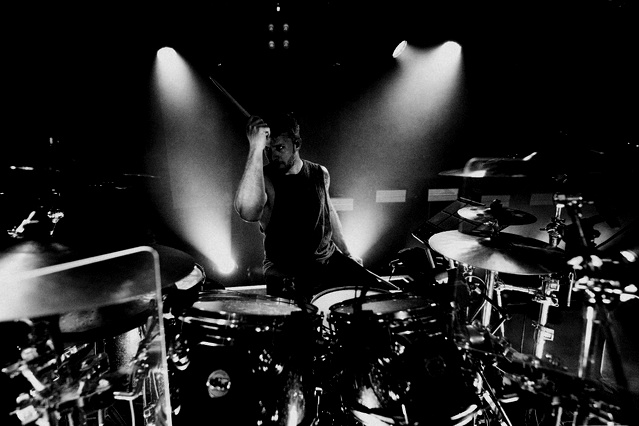
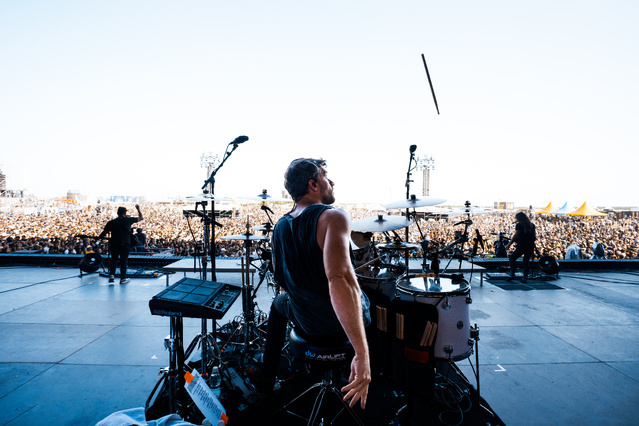
AUDIX microphones make it easy to get a great drum sound. they sound really good for rock.

What’s new with Nothing More?

We recently completed a successful European festival circuit; we hit festivals in 15 cities across 9 countries. We’re doing a headlining tour of Europe in November and will hit the U.S. from January through March. These will wrap up the Carnal album cycle. 

We also have a few one-off festivals scheduled, including Inkcarceration. For the upcoming tour, we’re developing a new show that incorporates more of the new album and builds it into a full show experience. After touring concludes, our focus will shift to working on the next album. Nothing More historically takes our time with these types of things, so we're trying to get a jump-start on the new material, having already produced a couple of demos.

What can you tell us about your other project, Without Sleep?

For me, Without Sleep is a creative outlet for things that I’d like to hear, without adhering to any rules of thumb. It started when I moved to Los Angeles. Singing isn't my strength, so I connected with my friend Ravi during COVID. He’s a very talented singer and lyricist who comes up with great harmonies. We initially collaborated on a Zoom-style cover of Radiohead's Exit Music for a Film, with me on drums, Ravi on vocals, and Emma from Sick Puppies and Evanescence on bass. 

After that, I sent Ravi some of my musical ideas, and he was interested, finding a shared vision both musically and lyrically, as we had gone through similar life experiences. We released an EP during COVID and recently finished mixing a new song after my move to Nashville. We plan on releasing that soon.

I value bands that carve out their own sound, and I seek out drum sounds that feel lively and impactful.

What is your drum microphone setup?

For my home studio and live rig, I exclusively use AUDIX mics. The AUDIX D6 is my go-to kick drum mic. It's unstoppable, especially for rock. I position it on a Kelly shoe system, centred in the kick but slightly ahead of centre. I also use another D6 on my 18" floor tom. The AUDIX D4 captures my 16" floor tom, and two AUDIX MicroDs capture the rack toms. 

The MicroDs pop great and are very discreet-looking. A pair of AUDIX SCX25A is used as my overhead microphones. I think they’re fantastic. They are also instrumental to my tom sound, which combines the overheads for the ‘body,’ while the MicroD provides the direct mic attack on tom hits. AUDIX i5s are positioned over the top and under the bottom of the snare drum. 

I use AUDIX f9s for auxiliary purposes, typically on hi-hat and ride cymbals, but hi-hat mikes are rarely crucial for my sound, as the overheads capture most of what I need. I should also mention that our front-of-house engineer also records every live show using AUDIX.

Can you walk us through your recording and production process and studio set-up?

For tracking, I'm a Pro Tools fan. I became proficient after attending the Conservatory of Recording Arts and Sciences in Phoenix around 2010. This background has proven invaluable because I prefer to handle all drum editing and comping myself for Nothing More albums. 

I don't like anyone to touch my drums, as I want final say to avoid others gridding the hell out of my performances or taking a fill and just completely flattening it. Staying personally involved makes it easier to execute my creative ideas. 

Sonically, I aim to keep everything very clean, retaining the details picked up by AUDIX when recording into any kind of DAW. I am not a fan of using lots of processing when tracking and typically apply only a light amount of EQ at that time, saving any processing for post.

While I’d love to have racks full of API preamps on my drums because I consider them the best on drums, my current setup includes a Focusrite Scarlett Octopre, an Apogee Ensemble, two Universal Audio Apollos, and an Apollo satellite, in total, providing about 16 inputs. 

I utilise Unison Preamps to emulate API preamps on the kick and snare, and 1073s for the overheads. All processing largely occurs through plugins within Pro Tools after initial tracking.

Can you share any secrets to getting a great drum sound on recordings?

I often use parallel bus compression on drum shells with a Decapitator plug-in to create a thick, roomy compression sound that combines a little bit of grit with a little bit of saturation. Black Sheep Audio's Silencer plug-in is a favourite for removing unwanted crap, especially on snare and toms. 

My home studio is nice, but it lacks a massive drum room. I also use a technique I call "sample adding" to emulate rooms, rather than full sample replacement. I take samples of my actual kit and snares from previous Nothing More sessions that were recorded in a big room. I then trigger these samples, focused only on the far room mikes, to create a sound specifically for the kick and snare.

Could you give some shoutouts to your peers who inspire you sonically?

I value bands that carve out their own sound, and I seek out drum sounds that feel lively and impactful. A few are: Animals as Leaders’ Steve Judd has an extremely signature sounding drum sound full of raw, organic tones; Nothing But Thieves new album, Dead Club City, has a great overall tonal quality, particularly the dead, thumpy snare drum sound; and Dead Poet Society’s last album had great drum tones that were crafted intentionally to have a vibey sort of feel. 

I also find Loathe’s effort to create a unique sound, encompassing drums, other instruments, and the overall mix, including shoegazy vocals, to be inspiring, and Gojira has been really successful in developing a unique sonic identity. You can identify their music just from the bass and drums. They’re kind of like Tool in that regard.

How did you first get exposed to AUDIX, and what’s your opinion of the brand today?

My exposure to AUDIX microphones began when I was working at Mind's Eye Digital Studio in Phoenix with Larry Elia. Larry was using AUDIX D2, D4, and D6. I immediately noticed they sounded really good for rock, and I came to realise that AUDIX microphones make it easy to get a great drum sound. 

After leaving that studio and moving to L.A., I switched exclusively to AUDIX. I had previously used a mismatch of other microphones. For me, the AUDIX D series microphones are spot on.

I hold a very positive opinion of the AUDIX brand and believe that, especially for a rock setting, AUDIX mics point everything in the direction that you want to go and do a lot of the work for you. 

In addition to their great sound quality, I love their durability; they don't break even if I accidentally hit them. I also appreciate their customer service – everyone is so responsive and friendly.