Subscribe
Live

Oasis Live ’25 boasts supersonic stadium sound thanks to L-Acoustics

The reunion the world spent 16 years waiting for finally arrived this year. Oasis’ Live ’25 tour didn’t just mark the return of Liam and Noel Gallagher to the same stage – it became the defining live event of 2025. What began as a 41-date, all-stadium run across 17 cities from July to November quickly ballooned, with three extra shows added as millions scrambled for tickets (commiserations to those that missed out). And with every stop turning into a packed, roaring sea of fans, Headliner discovers how Britannia Row Productions – part of the Clair Global family – rolled out a full L-Acoustics K Series sound system to deliver the sound worthy of a once-in-a-generation comeback.

While this marks Oasis’ first tour with the French loudspeaker manufacturer, L-Acoustics has been part of the Gallagher brothers’ sonic evolution for well over a decade. When Noel Gallagher’s High Flying Birds launched their touring career in 2011, FOH engineer Dan Lewis specified K1 and K2 arrays with precision-tuned subwoofer arrangements to nail Noel’s signature controlled low-end. 

Meanwhile, Liam’s solo tours packed the same punch, deploying a K Series setup for his explosive Definitely Maybe 30th anniversary tour in 2024, with K1 over K2 arrays and flown K1-SB subs.

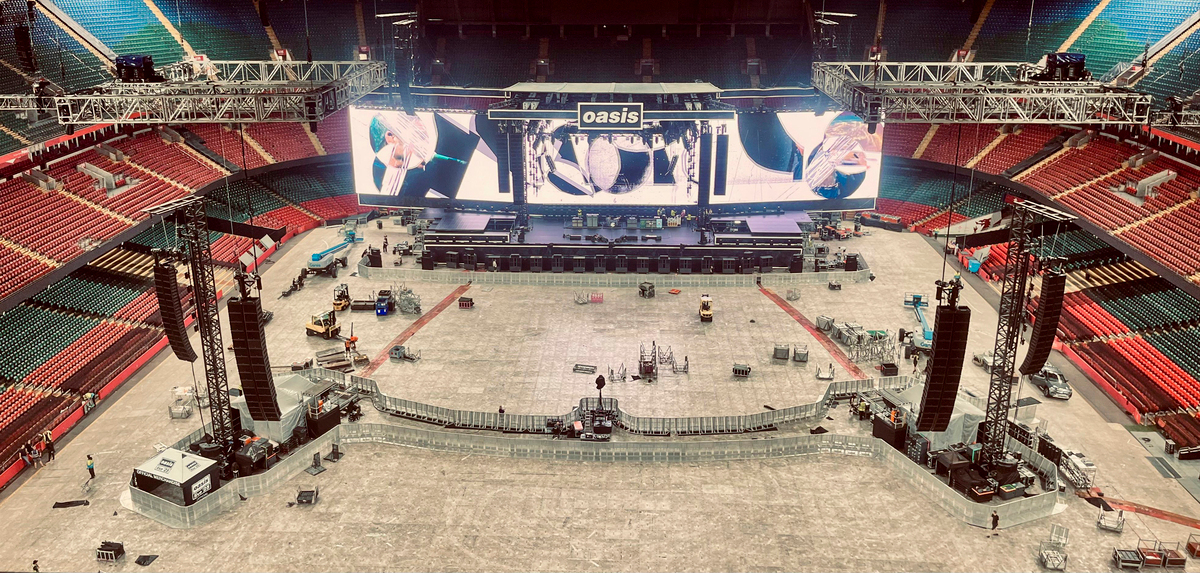
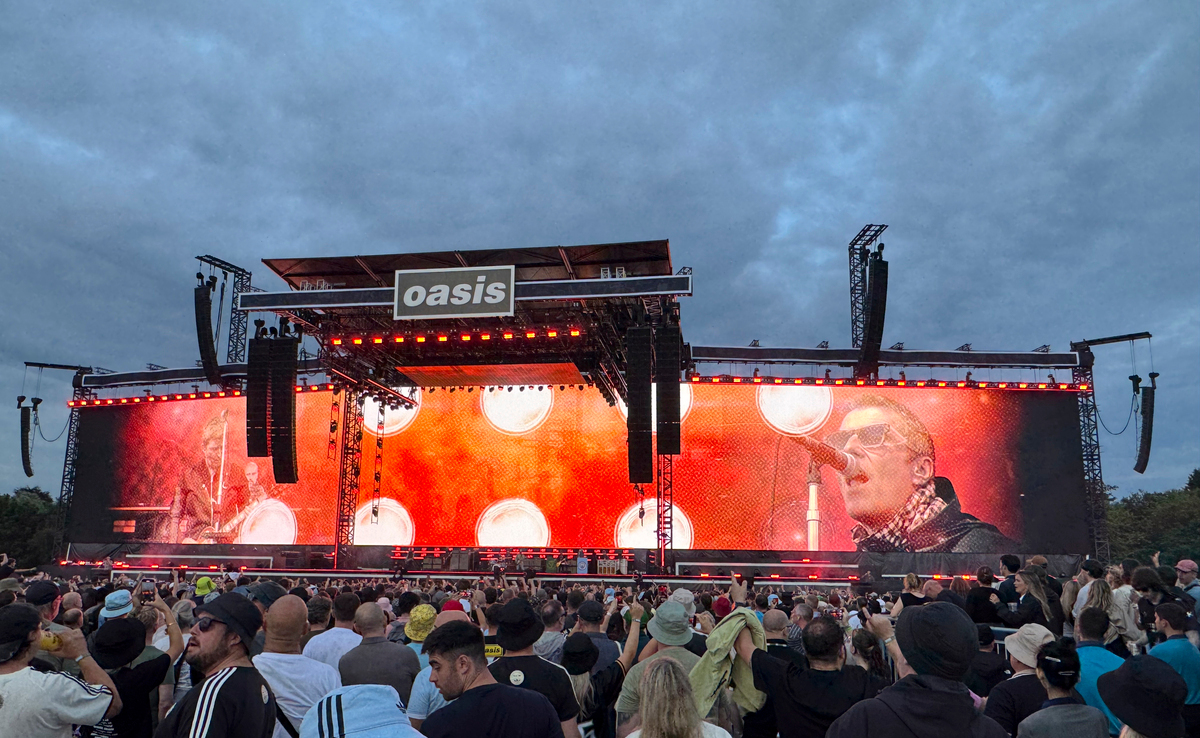
For the Oasis Live ’25 tour, the system deployment is even more grand in scale than either of the siblings’ separate ventures. The rig features main arrays of four L-Acoustics K1-SB subs over 14 K1 over two K2 per side, with left and right hangs of 16 K1-SB subs adjacent to each main, while rear 270° hangs add a dozen more K2 per side.
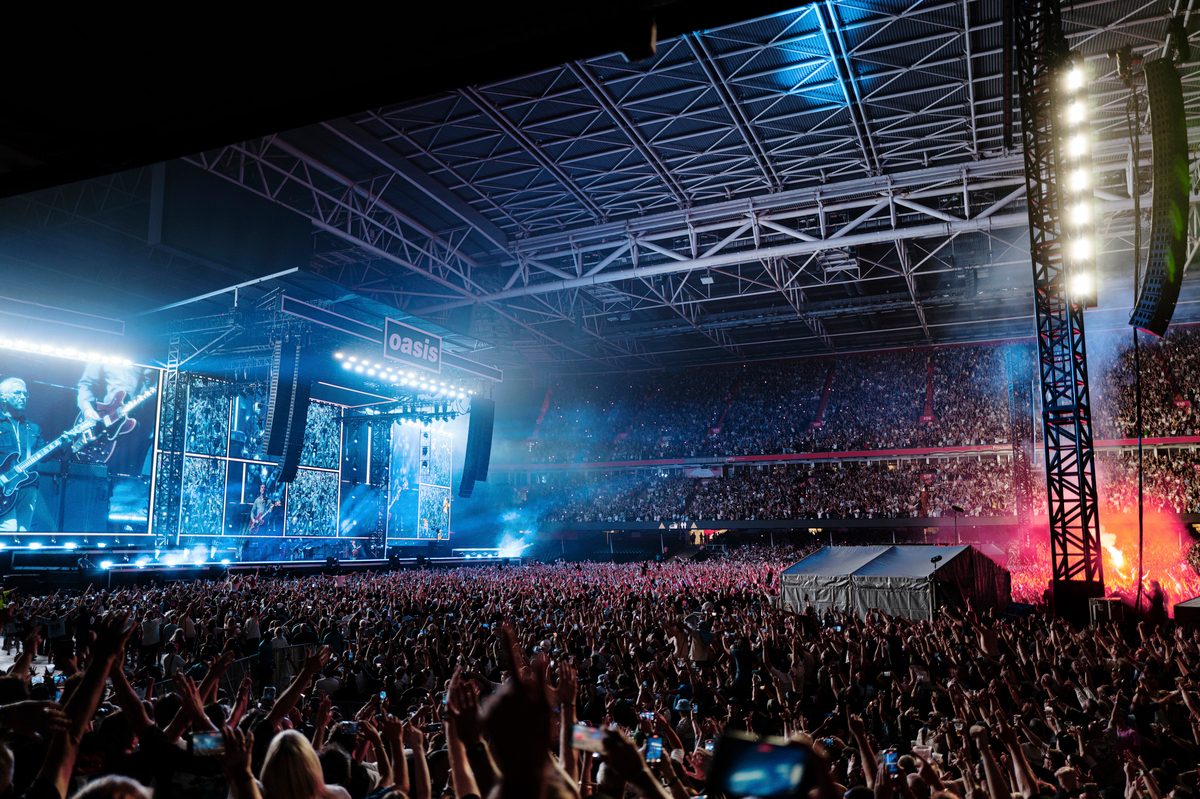
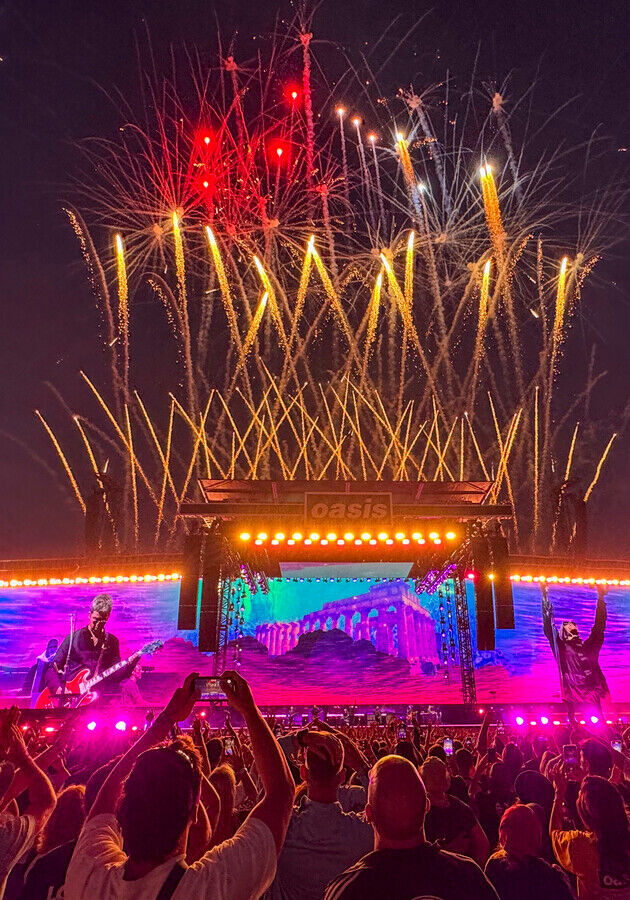
Liam, Noel, and the rest of the band delivered an amazing show night after night, which came through loud and clear.

Out-fill hangs were identical to the main arrays for the European run, but the audio crew swapped out the four K1-SB with four K1 in North America due to the higher venue heights. 

On the ground, four dozen KS28 subs are deployed in 16 stacks of three, all in a cardioid configuration, with six K3 serving as front-fills. Twenty A15 are utilised as out-fills, while another eight A15 are used as FOH shadow-fills.

The tour’s delay system typically consisted of four towers of 12 K1 over four K2, although that was upscaled to six towers for the band’s hometown show in Manchester to cover the field. And in venues where a ring delay system can be hung from the stadium roof, between eight and 11 hangs of eight K2 each have been flown.

The full system was more than amply driven by 136 LA12X amplified controllers, paired with a P1 processor at FOH, which were primarily used to run an analogue backup and to use M1 to tune the system.

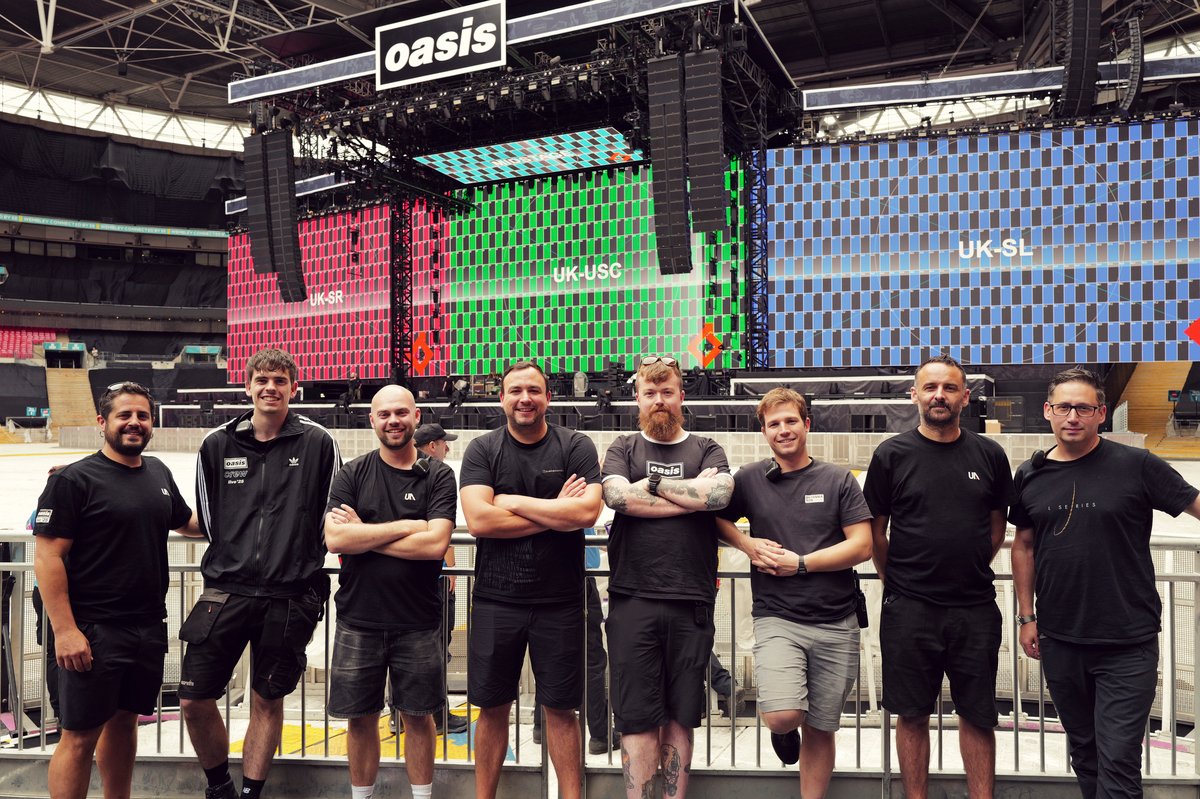
The tour’s crew chief and systems engineer, Ben Webb, who has also worked with Peter Gabriel, Thirty Seconds to Mars, and the K-pop band ATEEZ in recent years, is highly familiar with L-Acoustics, having taken Brit Row’s first L-ISA-equipped L Series arena touring system out with Andrea Bocelli earlier in the year.

For Oasis, Webb was tasked with crafting the Soundvision design for each tour stop and rigging the system for co-FOH engineers Lewis, who mixes Noel and the band, and Sam Parker, who mixed Liam’s vocals and effects.

“The original system design was done by Dan Lewis and Britannia Row head of engineering Josh Lloyd before the tour even went on sale,” said Webb, who estimated that he got in 35,000-plus steps a day walking each venue as he’s tuning the system, then again for soundcheck, and finally during the actual gig.

“I’m tweaking Josh’s original designs to match venue characteristics and any production changes. That being said, I have to say that the new version of Soundvision is better than ever. Show consistency with Autofilter is spot on, and it’s a vital tool in my workflow. I strive to get that consistent, even frequency response throughout the entire venue, and Autofilter helps me do just that.”

“We were also completely outdoors with this run and touring through different climates, which can change drastically from soundcheck to showtime, so Autoclimate has played an integral part in helping us keep that consistency throughout the full show,” he notes, adding that the optimal delay tower placement has also kept the sound uniform across the massive stadiums they play.

“But, of course, Dan and Sam both did an incredible job with the mix, too, which certainly helped achieve that sonic consistency each night.”

Webb credits L-Acoustics as being an ideal equipment vendor to partner with for the tour. “We’ve seen L-Acoustics ‘family’ at different shows all over the place, and it’s been great to meet some new faces and continue to provide feedback to help improve products and workflow,” he said.

“They’ve been very supportive, and we couldn’t have asked to be treated any better. But my favourite thing about L-Acoustics is that you get out of their systems exactly what you put in, and Liam, Noel, and the rest of the band delivered an amazing show night after night, which came through loud and clear,” he added, adding that the responses from audiences, both online and in person, have been incredible.