
Subscribe
Music News

Lawo to announce “groundbreaking innovation” as part of media-infrastructure strategy

Lawo is set to introduce “a groundbreaking innovation” that forms the next major step in the company’s converged media‑infrastructure strategy in the run-up to the 2026 NAB show in Las Vegas (April 18-22), where Lawo is to showcase its HOME platform.

First revealed during Lawo’s global online event, which will take place on April 8th, the new solution aims to make system setup quicker and easier, and organise operational efficiency across broadcast, recording, live performance and corporate AV environments. It aligns with the broader industry movement towards software-based media facilities.

Lawo’s HOME platform is the foundation of Lawo’s IP ecosystem. HOME management now supports role-based access control (RBAC) and provides services such as device discovery, authentication and orchestration. These capabilities allow production infrastructures to adapt their available resources and processing power in real time.

HOME apps also offer containerised microservices that run on COTS servers and can be deployed, scaled, and reconfigured as workflow demands shift. Together, these systems enable a facility model defined by rapid, workload‑based resource allocation.

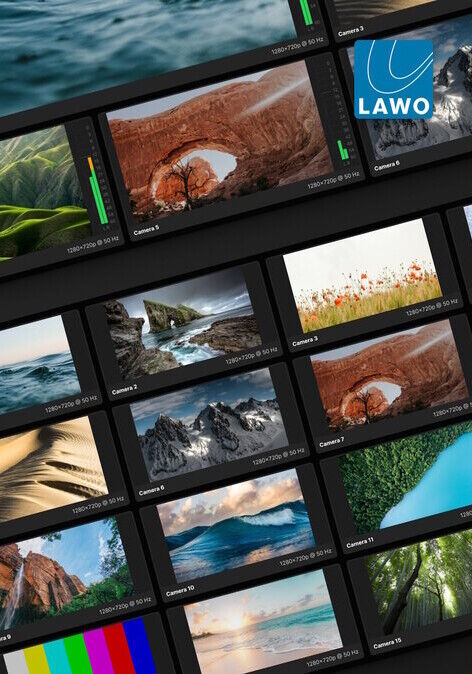
At the 2026 NAB show, in booth C2108, Lawo will showcase a series of HOME Apps. Among the featured technologies is HOME Multiviewer, a server‑based, ultra‑low‑latency processing app supporting SMPTE ST2110, NDI, SRT, and JPEG XS workflows. The HOME Multiviewer can generate multiviewer layouts - up to 64 picture-in-picture tiles - and has a resolution-management system that operates in conjunction with Lawo’s .edge platform.

This mechanism can select either full-resolution feeds or proxy streams based on PiP size and operational context, resulting in improved CPU usage and reduced bandwidth overhead, while maintaining precise monitoring quality.

Additionally, the HOME Apps portfolio includes real-time UDC conversion with HDR processing, graphics insertion, stream transcoding, and a broad set of tools for colour correction, timecode generation, test patterns, tone generation, and audio DSP. Each application can be launched and stopped on demand, creating a processing environment that supports rapidly changing production requirements and aligns with the Dynamic Media Facility (DMF) as well as the Media Exchange Layer (MXL) initiatives.

Lawo will also present the latest software generation for its mc²36, mc²56 and mc²96 production consoles and its crystal on-air mixing systems. The new mc² release introduces an improved Strip Assign workflow to accelerate channel configuration and improve visual clarity, while integration with Waves SuperRack via the ProLink protocol improves real-time plug-in workflows. EBU R.143-compliant security features protect systems in interconnected IP production environments.

The HOME mc² DSP engine extends mc²‑grade mixing capabilities into the software domain. It runs on generic CPU platforms and supports thousands of input processing channels, immersive production formats, extensive bussing structures and collaborative mixing functions.

The University of Nebraska’s Huntervision installation is a project illustrating the capabilities of Lawo’s unified IP infrastructure. The campus-wide ST2110 deployment connects multiple sports venues to centralised production control rooms using Lawo’s .edge platform.

The system supports 3G and 12G‑SDI ingest, native ST 2110 connectivity, and bandwidth-optimised proxy workflows for the HOME Multiviewer app. HOME Apps are also used for UDX conversion, while the venue’s integrated 24×24 truck‑dock exchange enables HDR, SDR, SDI, and ST2110 interchange with national broadcasters—all within a single, unified IP fabric.

Lawo’s full suite of IP‑native routing, software‑based processing technologies, and resource‑management tools will be on display at NAB Show 2026, booth C2108.