Subscribe
Live

L-Acoustics deployed for Nine Inch Nails’ sold-out arena return

Britannia Row and FOH engineer Jamie Pollock deployed an L-Acoustics K series system across all 22 North-American dates of Nine Inch Nails’ Peel It Back Tour.

The tour kicked off in Ireland in June 2025 and ended on March 16, 2026. The third leg of the tour - a 22-show run across the US and Canada - was supported by a large L-Acoustics K1/K2 rig, with KS28 subs provided by Britannia Row Productions.

“This was a ‘standard’ K Series arena spec for me,” said systems engineer Terence Hulkes. He noted that the enclosure count on the Peel It Back Tour was slightly higher than usual, not only for extended headroom but also to accommodate greater vertical dispersion in higher-roofed arenas, and, where necessary, 270-degree coverage. “I like to use the angles to fine-tune SPL target coverage and frequency response without the restriction of simply not having the box count for it to be an option.”

In total, this third leg of the Peel it Back Tour featured main hangs of 16 K1 over four K2 per side, side arrays of 12 K1 over eight K2 per side, with 16 K2 per side for the rear 270-degree arrays. Eight KS28 subs were flown per side with another 24 K28 end-stacked in pairs across the stage face.
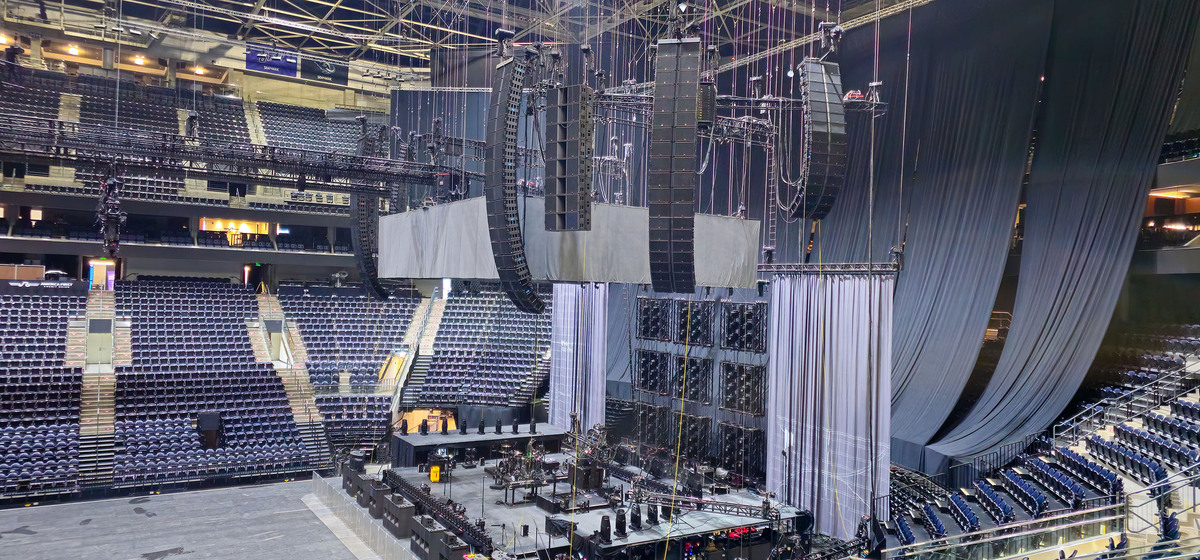
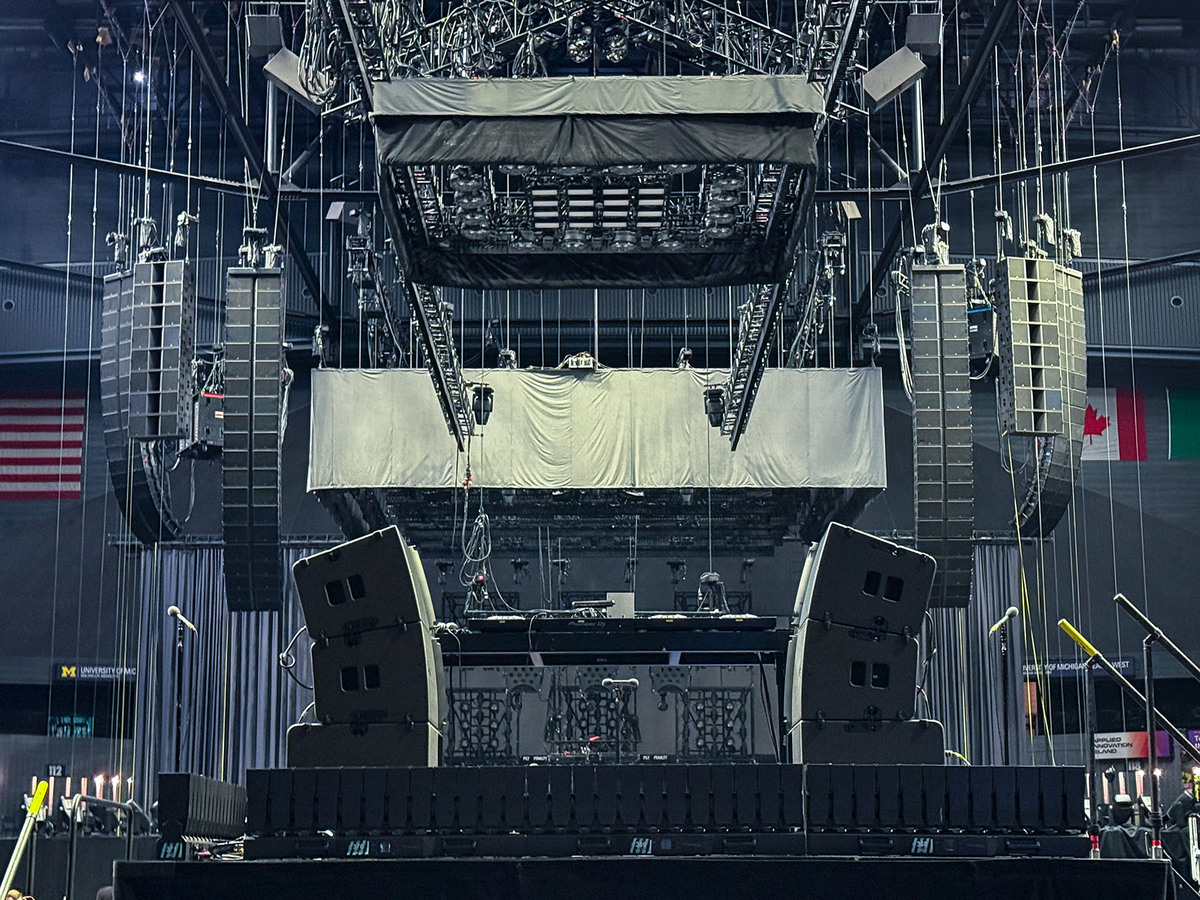
Four A10 Focus spread out atop the ground subs provided front-fill, with an additional four horizontally arrayed A15 Wode per side for near-out-fill. “We also carried four X8 with pole-mount brackets as auxiliary front-fill,” said Hulkes. “We used them when necessary for hard-to-cover odd spots around the stage.”

Thirty LA12X amplified controllers per side were flown in custom Britannia Row flying carts alongside the arrays, with another six per side on the ground under the stage. Processing included three L-Acoustics P1 at FOH using dual-redundant Milan-AVB signal distribution with analogue XLR backup.

Jamie Pollock was recently appointed an L-Acoustics Artisan of Sound. He is a veteran systems designer and FOH engineer, with credits spanning Radiohead, Depeche Mode, Peter Gabriel and the Grammy Awards telecast. He has been touring with the K1 system since its pre-launch beta release, at first with Radiohead, and then with other early adopters. Pollock describes the rig design as a true collaboration.

“I discovered the art of a systems engineer working with Radiohead, but always considered myself more of a mixer,” he said. “Understanding the system and design is essential to me as a front-of-house engineer. When we start a tour, I’ll have the initial conversations, design system options, and then bring Terry into the conversation so I can get his thoughts and opinions. My role these days is more of a mixer and a producer, so at a certain point I hand it off to him, and he takes it to the next level.”

None of the subs on this tour were in a now-typical cardioid configuration. “I think there’s a time to use cardioid, but I prefer the sound of subs when all the drivers face the same direction,” said Pollock. “I never really have a problem with low end, and to me, subs are just an extension of the full-range sound we get out of these large arrays. When I tune, I start with just the mains and get that right first. As we add subs, it’s adding in a musical way, and then having the correct amount of subs and configuration gives us the control.”

The show started with the focus on Trent Reznor at a B stage piano in the audience, before switching to the A stage with the full band, consisting of Reznor, Atticus Ross and three touring band members. The focus then returned to the B stage for performances with Boys Noize before again returning to the main stage for NIN’s final set.

“The B stage started with an ‘acoustic’ feel with some live mic elements and then built to a lot of electronics, drum machines, and synthesisers,” said Hulkes. “We only used the main stage PA for this. We made sure the floor coverage of the PA was consistent in SPL and frequency response during design and tuning and achieved very respectable levels for that part of the show.” 

Every system has its own sound, and the K-Series just does something that people like. Terence Hulkes, systems engineer

Hulkes used the Autofilter in L-Acoustics Soundvision software to get a baseline FIR balance for the arrays. “Then I walked the venue to align and calibrate the PA with L-Acoustics M1 suite and listened to verify and fine-tune manually to taste,” he said.

The L-Acoustics sound system was networked via Milan-AVB on the tour. “That definitely simplified the signal routing and was much more flexible and configurable in software without having to manually re-patch input cabling,” Hulkes said. “It was also great to have the software routing available with the main amp racks flown in the air, as they’re not the easiest to access to move cables around when they’re hanging about 60 feet up in the roof. Also, having AVB I/O on the front end of the P1 processors was a necessity to handle all the required input for system utility, I/O, house feeds, etcetera, as all connected devices could access the AVB streams over the network.”


“Every system has its own sound,” Hulkes concluded. “And the K Series just does something that people like. I’m always excited to see what’s on the horizon with L-Acoustics and to get the opportunity to try out new products and developments in the field.”