
Subscribe
Headliners

How OK Go created their trippiest music video yet using 64 iPhones

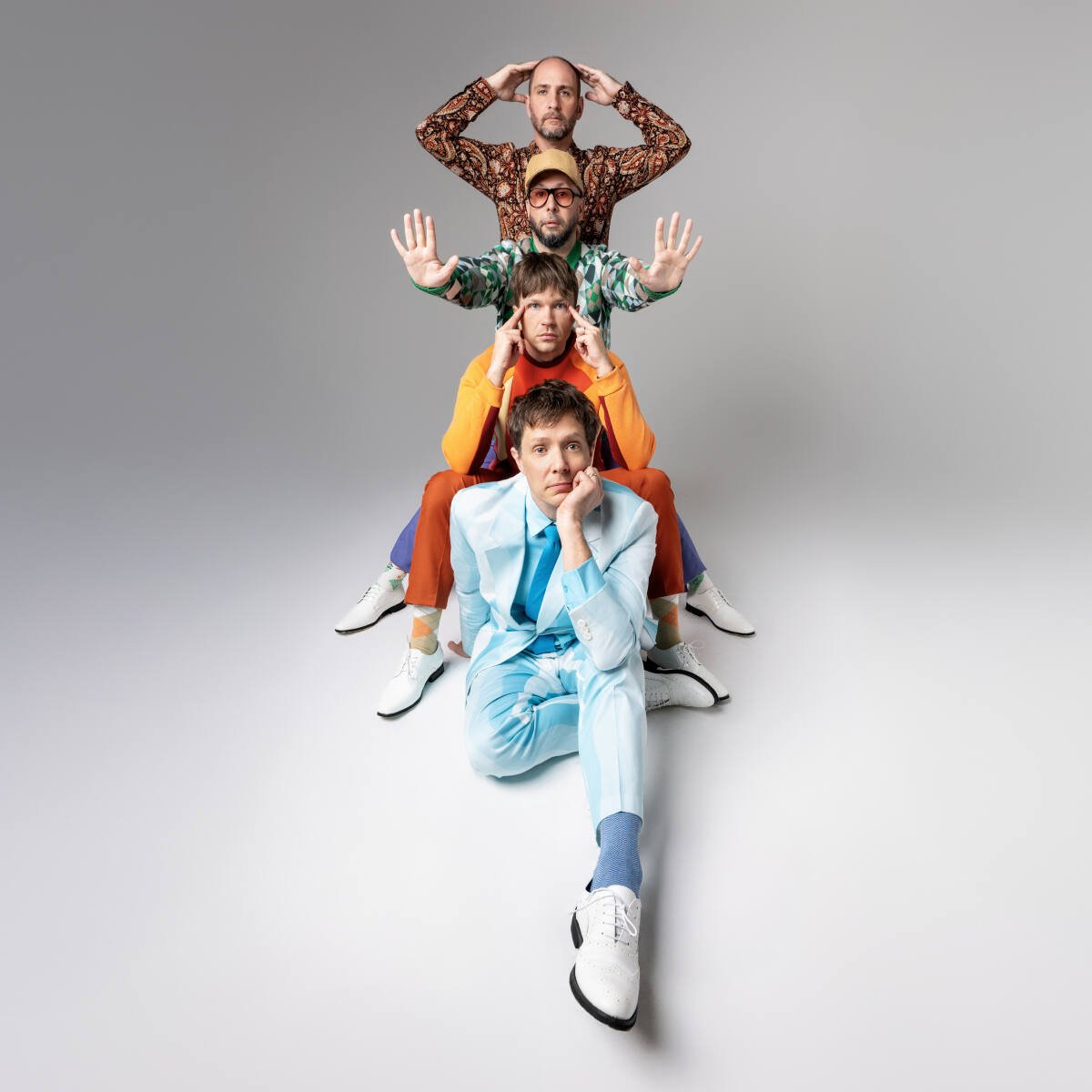
OK Go are the ultimate band to go above and beyond and over-deliver with every single they release, hence the Grammy award win for their outrageous treadmill choreography music video for Here It Goes Again, with 67m views on YouTube alone. The new single, A Stone Only Rolls Downhill, doesn’t disappoint with its video, which was created using 64 videos filmed on 64 individual iPhones. Frontman Damian Kalush discusses the new song and creating the mind-boggling video with Headliner, and teases And the Adjacent Possible, their upcoming new album and the band’s first in a decade.

In a time before the band became notorious for their concept-heavy and outrageously ambitious music videos, OK Go broke through in 2001 with the single Get Over It, appearing in games such as Madden NFL 2003, and Guitar Hero 5. 

Having formed in 1998, this relatively early success saw the band riding the wave of the early noughties explosion of indie rock, sometimes later disparagingly referred to as ‘landfill indie’ due to the sheer number of bands being signed to labels to try and match the success of OK Go, as well as the Strokes, Yeah Yeah Yeahs, Razorlight, and too many to list here.

The rate of bands from this era still going is small, but OK Go have gone from strength to strength. The Get Over It video is, by their own standards, quite low stakes. But, in a sign of things to come, the band did market themselves by sending out miniature ping pong tables to press outlets in a reference to the video.

Things stepped up in 2005 as the band released A Million Ways, another showcase of OK Go’s organic viral promotion, as new guitarist Andy Ross programmed 1000000ways.com, a website that allowed fans to listen to and share the track for free. Then came the video, in which the band performed a dance choreographed by Kulash’s sister, Trish Sie. 

It became the most downloaded music video ever with nine million downloads, and saw the band performing the dance on British Saturday morning football show Soccer AM, of all places.

And then, also for the band’s second album Oh No, they achieved their destiny of fusing their alternative indie pop with some of the greatest DIY music videos; while becoming a very pop culture/indie version of the gesamtkunstwerk (total artwork). 

This was with the music video for Here It Goes Again, again choreographed by Trish Sie. Only this time, the band performed their dance on eight treadmills, as they moved from one machine to another in one continuous take. It took them 17 attempts, and was uploaded to YouTube in the very early days of the website, now clocking 67 million views (it would be double this number if a dispute between YouTube and OK Go’s then-record label hadn’t seen the video removed).

We didn't plan 'Here It Goes Again' as a proper video. We thought it was just for our nerdiest internet fans.

Kulash joins the call, and first up is whether his artistic ego is ever hurt by music journalists inevitably focusing their questions on OK Go’s videos, perhaps more so than the music itself. Thankfully, that’s not the case for the group.

“We didn't plan Here It Goes Again as a proper video,” Kulash says. “We thought it was just for our nerdiest internet fans. The only idea for distributing that was to put it on these download sites where IT department folks would download it. We'd seen something go viral before like that [A Million Ways)]. 

"We thought it was so funny that they like this weird homemade shit that we do. We had no idea that it would wind up on MTV and VH One and get Grammys. And now, our gravestones will say ‘those treadmill guys’ on them. And we’ve embraced it. I don't think you can dance on treadmills and then be like, ‘No, we’re too cool for that,’” he laughs.

“I think that the only thing we're all looking for as artists and with our music and videos is human connection and getting outside that noisy isolation of our brains: the neocortical chatter of yourself, the logic and the words, and the motivations. I'm sure there are neuroscientists or evil social media architects who know exactly which chemicals flood your brain when listening to music that we love. 

"For me, it’s that release of love or sadness or excitement, or optimism, and 10 variations of these things all at once that could never really be described.”

Visually, things ramped up from there as the band’s own expectations increased, and as the music video budgets began to increase exponentially. Another huge moment for OK Go was This Too Shall Pass, another trademark one-take video with an outrageously elaborate Rube Goldberg Machine partly designed by the band themselves, seeing dominos, balls, and toy trucks triggering a staggering chain of reactions.

Then there was 2012’s Needing/Getting, a collaboration with Chevrolet as OK Go perform a live take of the song. Besides the band performing themselves in the car, the vehicle deliberately collides with pianos, guitars, percussive tin cans, and much more to create the music. 

It totals 1,000 instruments over two miles of desert, with Kulash himself driving said Chevrolet while singing the lead vocal.

Our gravestones will say ‘those treadmill guys’ on them. And we’ve embraced it.

Perhaps OK Go’s peak moment in terms of sheer ambition was Upside Down And Inside Out. The video begins with the text: ‘What you are about to see is real. 

"We shot this in zero gravity, in an actual plane, in the sky.’ If you somehow haven’t seen it, it’s probably best to let the video speak for itself — just be careful to cushion your jaw as it hits the floor.

Regarding the origin story of new single A Stone Only Rolls Downhill, Kalush says, “This song has been floating around in little pieces for years, since our third album, about 15 years ago. Then I came across the demo again, and it sounded to me a lot like the melancholy that I have with the world right now. 

"There's this split screen style of life that we're all living, where the only way to get from one day to the next is to be hopeful in some way and have faith. Because things do get better and things do work themselves out. But, man, there's so many things pointing in the wrong direction right now. And I have two young kids, and that pulls all of this into focus: what do you tell your kids about climate, war, fascism and AI. You can't say, ‘Look, kids, the world is fucked!’” 

If you’ve ever felt the symptoms of a migraine beginning when trying to contemplate how OK Go plan their music videos, you might want to have a packet of ibuprofen ready for this latest visual piece from the band. 

Not only is it nigh impossible to imagine planning such a thing, but it has also produced one of their trippiest music videos yet. A Stone Only Rolls Downhill’s video was created with 64 phones, each containing one take of the video. 

A camera films each of the phones' screens, as we see the band weave from one screen to the next, and as more and more of the phones appear, things get increasingly psychedelic. Kulash co-directed it himself, while bringing in some heavyweight talent in the form of Chris Buongiorno, producer on projects such as Spiderman: No Way Home and Star Wars: Skeleton Crew.

We did 1,043 takes, it took eight days to film. It’s all human, and there’s no CGI.

In terms of the linear process, Kulash says that he writes the lyrics first. “I can't keep video ideas in my mind while we're writing. But it did provide this framework, that split screen, fractured self idea led to the video directly. We're not trying to literally describe the lyrics. 

"We're trying to extend that feeling out into the video. You wind up with these big, broken mosaics of images, and it is very surreal and psychedelic. It's sort of monstrous at times because of how weird people look when you've broken them apart like this. And it is playful and joyful at other times, and it's very colorful and fun, but kind of unsettling. Hopefully that's pulling out that dimension of the song rather than simply describing it.”

And to get an idea of the sheer amount of labour that went into creating this thing, Kulash explains: “We did 1,043 takes across the 64 final things we did. It took eight days to film. It was basically us filming the same routine over and over again with small changes. 

"We're doing it in four different colour outfits, so that you see us walk from phone to phone, and on one phone we're all in green, and the next phone, we're all in pink, the next one, we're all in brown. And it helps you see that each one is its own distinct video. And one of the things I love is because it’s all human and there’s no CGI, it doesn’t always line up right and you get these fissures and fragments where our faces aren’t quite in sync.”

OK Go’s fifth album, And The Adjacent Possible, will be released April 11th, over a decade after Hungry Ghosts. One reason for the long wait is Kulash co-directing The Beanie Bubble with his wife, screenwriter Kristin Gore, starring Zach Galifianakis and Elizabeth Banks. The promise of more quirky indie goodness and bonkers music videos from the band can only be tantalising for OK Go’s army of fans.

That excitement is, of course, shared by Kulash, who signs off by sharing: “When the album comes out, there will be a new video with it. We’ll be leaving the country to go film that, which I'm really excited about. 

"It's so different to the part where you're working on just the sound, and I sit between a pair of speakers with my eyes closed, just trying to get the feeling right. And now it's like a million moving parts and videos and running our label, and it is such a different beast at this moment in time. But it's always fun.”