
Subscribe
Broadcast

"I’ve never met a Lectrosonics piece that wasn’t a beast in the field”: Capturing Magic with High Five Sound

High Five Sound has delivered exceptional location mixing and post-production services for documentary, reality, auto racing, and news programs across a wide range of platforms, including A&E, Bravo, CMT, ESPN, Freeform, MTV, and Vice, for almost 20 years. Company founder, Edson Alvarez shares his highlights of how High Five Sound handles complex assignments and how it has come to rely on Lectrosonics products to capture the best possible audio in often challenging circumstances…

Alvarez’s passion for mixing began early.

“My dad played guitar in a band, but oddly, that gave me an interest in mixing rather than playing,” he recalls. “I graduated from Full Sail University in 2001 with a degree in Recording Arts. I did the music production thing for a while, then wanted to get into TV.”

A young Alvarez secured an internship at a reality production company called Pink Sneakers, mentored by a mixer named Jimmy Van Winkle. “He taught me everything I know, and he always used Lectrosonics. He’d order several pieces for an upcoming show, and I’d put together the kits, which caused me to appreciate how solid Lectrosonics is. Through rain, snow, sand, heat, or cold, it will never give up on you.”

One particularly memorable challenge came while working on a reality-survival competition in Fiji. “We had a total of 20 SMDB and SMDWB transmitters on cast members, and though we wrapped them up pretty tightly, some would inevitably come back having taken on salt water.” With no time to replace damaged gear, Alvarez and his team relied on ingenuity to revive the equipment.

“My supervisor had read that you could disassemble a pack, remove the batteries, expose the motherboard, and clean it with distilled water. Then, you dry it out in the sun. I’m not saying to try this at home, but we had no choice, and it worked. If we had this kind of accident, we could get packs back up and running in about three hours.”

I did the music production thing for a while, then wanted to get into TV.

Closer to home, promotional and documentary shoots inside Disney theme parks brought different challenges. “Walt Disney World is, as you’d imagine, a very active RF environment because of all the things which are under some kind of radio or remote control,” Alvarez explains. “I usually have to stay in the A1 block, but I can always find six or seven channels I can use, thanks to Lectro receivers’ ability to find and hang onto frequencies. I was there for four days, working across three different parks. I was able to use mostly the same frequencies all the time, which was surprising given that I had four or five people miked at all times.”

Sometimes, this work takes the High Five crew deep into the ‘belly of the beast’ to show viewers how Disney works its animatronic and multimedia magic. “Sometimes we need IFB inside a ride,” says Alvarez. “For this, one of my bags is always equipped with a T4 transmitter, as if necessary, it can go up to 250 milliwatts of output power, which is more than enough to cut through all the metal in the structure and the RF in the air. Next to my SRCs, I also still use the UCR411 even, and honestly, I think it has a certain magic about signal acquisition.”

Another Florida staple, the Daytona 500 NASCAR race, is where Alvarez’s team achieved exceptional range despite the RF-heavy environment. “The Daytona International Speedway is also an RF-heavy environment during an event with all the two-way radios and TV crews on site,” he said. “I was once shooting a pre-race test drive and had to set up in the stands with fin antennas. We could receive the driver’s voice around the entire run of the track, which I didn’t think would happen.”

I’ve never met a Lectrosonics piece that wasn’t a beast in the field.

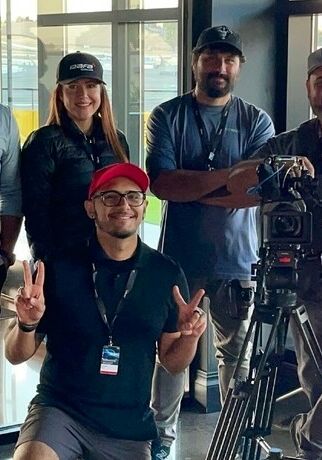
Edson’s most recent gig, for the Rafa Racing Club at Florida’s Sebring Raceway, was a frequency coordination challenge. “I have eight channels in my bag for mics,” he explains. “We use two scanners to hone in on the conversations going on between drivers and crews. Then there’s the IFB for the producers, which I have on T4 [transmitters]. At one point, we couldn’t find the coaches but we had their signal. The producer was impressed, and he was probably 70 yards from our position. That gives me a lot of confidence in Lectrosonics.”

Looking ahead to future projects, Alvarez is excited to audition the DSR4 digital four-channel receiver into his workflow.

“My SRcs and 411s have always had great sound quality, so I’m looking forward to comparing them,” he notes. “Four channels in a single slot mount, plus backward compatibility with all my transmitters, sounds interesting. But I already know this - I’ve never met a Lectrosonics piece that wasn’t a beast in the field,” he smiles.