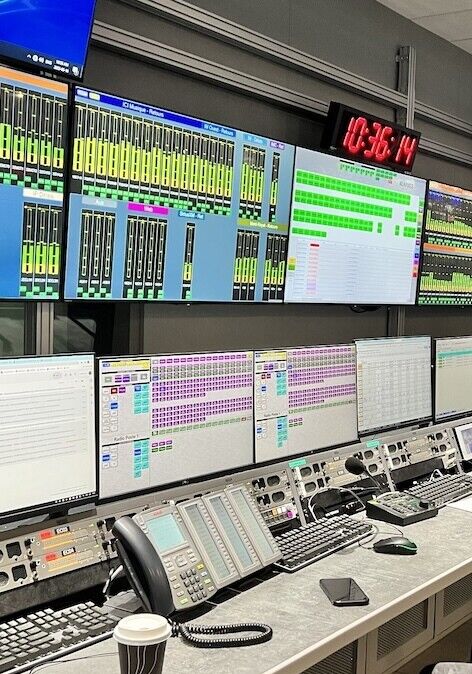



For its live-event-based streaming services, CBC/Radio-Canada, the country’s national public broadcaster, now accommodates up to 80 streaming events simultaneously using only two instances of Lawo’s HOME mc² DSP app.
This highly compact and functional workflow allows CBC/Radio-Canada to instantiate processing channels for sporting and entertainment events, press conferences, simulcasts, and more. The primary use case for audio shuffling is to correct non-standardised audio sources received from venues where live events are held to prepare them for airing on digital outlets, such as O&O, Gem, CBC.ca, and third-party services such as YouTube, FAST channel programming, etc. This is often used for university sports, government news conferences, Olympic events, and more.
Many media sources arrive with non-standardised audio streams that require digital streaming operators to use an audio shuffler function to manipulate the audio prior to digital streaming. Audio on channels 3 and 4, for instance, is remapped to channels 1 and 2; the gain of soft audio is increased; off-tube commentary is added to the stadium sound; 5.1 sources are downmixed to 2.0, etc. In all cases, the goal is to achieve a standardised 2.0 audio stream for live events that are streamed to the web using downstream AWS Elemental encoders.
Given the number of possible combinations and channels, CBC/Radio-Canada was looking for a flexible SMPTE ST2110-based solution to replace legacy, single-purpose hardware used so far, and to also introduce the ability to scale up and down the number of audio streams that can be processed simultaneously beyond the limitations of the previously-used hardware devices.
“Today, one app offering as many shuffling instances as we need can be controlled using VSM to provide us with the required agility,” said Jaime Thomas, supervising technician, digital presentation at CBC/Radio-Canada.
