Subscribe
Sports

How Binghamton University students produce ESPN-level broadcasts using Riedel SimplyLive system

At Binghamton University, the evolution of student-run sports production is being driven by smart technology and real-world demands. This year marks a milestone for Binghamton University’s Athletics, celebrating the university’s 80th anniversary and 25 years competing at the Division I level. As output surpasses 120 broadcasts annually, Riedel’s SimplyLive RiMotion R12 is streamlining replay workflows and enhancing efficiency, enabling student operators to deliver polished, professional-level coverage with speed and precision. 

SimplyLive RiMotion R12 empowers a student crew of 60-70 operators with the tools to deliver high-quality productions. The addition of this replay system has enhanced the university's game coverage, improving production quality, with approximately half of its annual productions now using Riedel’s replay system, allowing operators to cue replays and transitions much faster than before.

“Our production program has grown tremendously over the past few years, and what makes it special is that it’s almost entirely student‑run,” says Jeremy Donovan, video production and multimedia coordinator, Binghamton University Athletics. 

“Most of our students come in with no broadcast experience at all, but they learn quickly and end up producing ESPN‑quality shows across more than a hundred live events a year. Tools like the SimplyLive system make that possible because they’re flexible enough for beginners while still giving us the capabilities we need as our broadcasts expand onto ESPN, SNY, and MSG.”
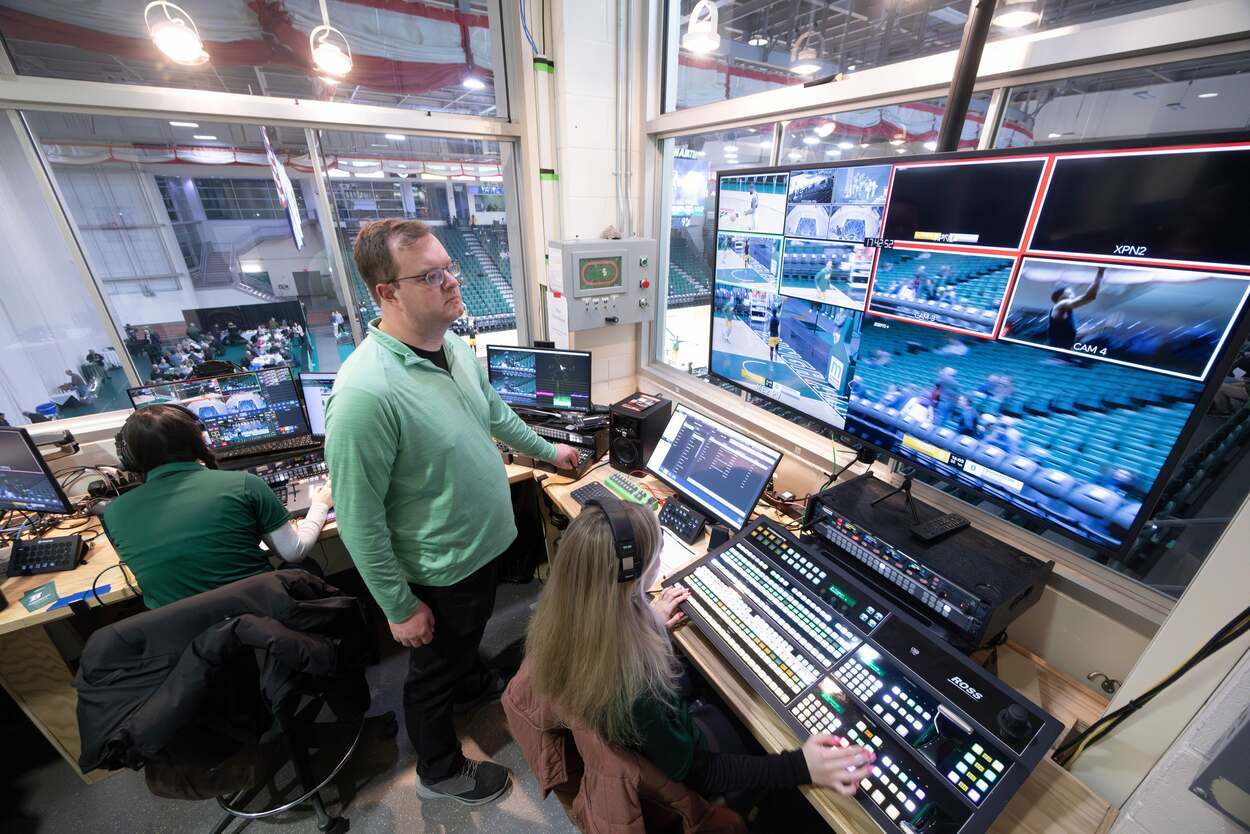
Most of our students come in with no broadcast experience at all, but they end up producing ESPN‑quality shows.

The upgrade replaces the university’s previous replay solution, which had reached the end of its operational life after years of steady growth in production volume. 

Since entering its ESPN partnership, Binghamton has grown from streaming a handful of basketball games to producing full broadcasts for football, volleyball, wrestling, baseball, softball, and men’s and women’s lacrosse. Students handle nearly every production role despite most having no prior broadcasting experience, joining the program from majors such as nursing, engineering, business, and political science.

The SimplyLive system gives students a workflow they can adapt to quickly, whether they prefer touchscreen control, a hardware interface, or a mix of both. In a recent playoff game, student operators used RiMotion to assemble a multi‑angle replay of a buzzer‑beater within seconds.

“One thing I appreciate about this replay system is how approachable it is for our students,” Donovan points out. “They can run it the way that feels natural to them – whether that’s staying on the controller, which offers the T-bar and jog wheel for more precise control, relying on the touchscreen, or combining the two.

One of the big reasons we chose the Riedel system was the ability to export clips while we’re still creating them.

“One of the big reasons we chose the Riedel system was the ability to export clips while we’re still creating them. That lets us quickly move highlights out of the replay system, convert them, and upload them within minutes so the athletics social team can share highlights almost immediately after key moments happen.”

Students now reconfigure the system before nearly every game, shifting between four‑camera basketball productions with added PTZs and simpler two‑camera lacrosse setups, and the browser‑based configuration allows these changes to happen quickly and easily, even during busy weeks with overlapping events.

The R12 system also gives students an efficient browser-based configuration module to easily change the setup between games, which vary in camera sources and playback channels. The flexible options offer up to 10 camera sources and up to four playback channels to meet the varying production demands.

“SimplyLive’s design fits the realities of a student‑run environment,” adds Andrew Grant, sales manager, live production, at Riedel Communications. “It gives operators a workflow that’s easy to learn and flexible enough to match different skill levels, while still delivering the responsiveness needed for high‑profile broadcasts.”

“For programs like Binghamton that are producing more events every year, it’s a practical and reliable way to keep their coverage growing,” he concludes.