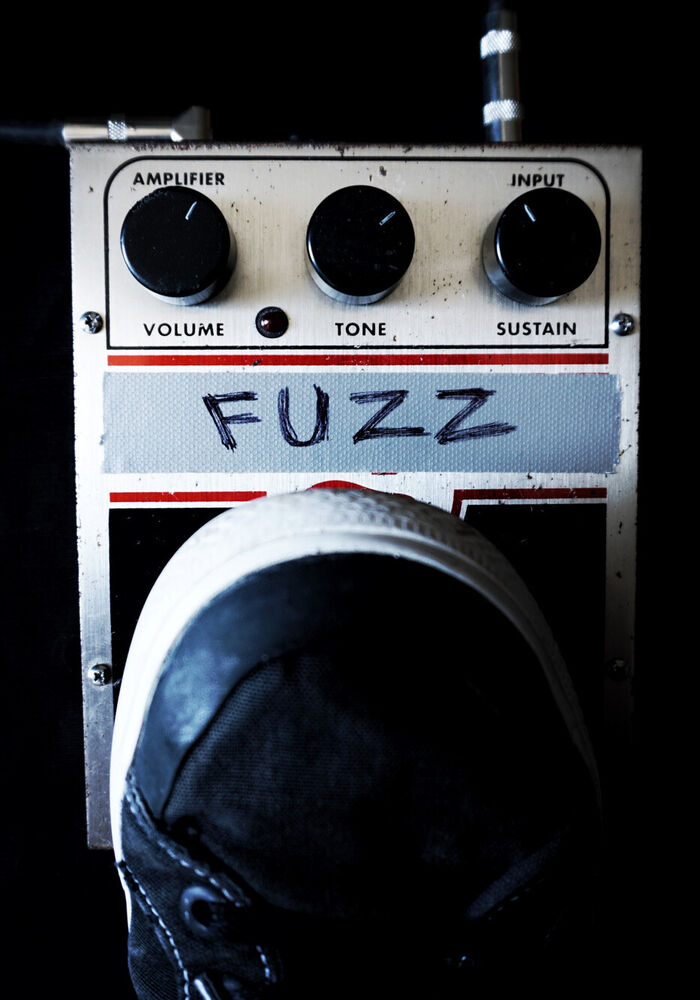
Without getting too warm and fuzzy on you, it’s no exaggeration to say that a fuzz pedal can be a true weapon for a guitarist. And one of the coolest things about these little joy boxes is the spectrum of variety they bring; one fuzz pedal can sound almost entirely different to the next. The only downside to this, and the fact that there are so many of these things, is a big case of buyer’s overwhelm. Which brand to go with? How much should I spend? Fear not, because the best fuzz pedals come in all shapes and prices, and this Headliner guide will guide you through the 11 best units on the market, starting with the most affordable and heading up to the most premium.
Electro-Harmonix Op Amp Big Muff
Pro: Iconic Wall of Sound tone, compact footprint, and extremely affordable.
Con: Can be too aggressive for players who prefer subtle, amp-like breakup.
While certainly not the most PC product title in the music tech industry, especially if you live in the British Isles, don’t let that be a reason to not get yourself one of the best budget fuzz pedals known to man. Electro-Harmonix’s take on the Big Muff sound costs less than £/$100, and brings you a legendary sound, via its nice and simple display of volume, tone, and sustain, plus a bypass switch if you need to rest the tone. In terms of sound, you can replicate the tones of some iconic bands with plenty of crunch and grungy notes, while thickening up your chords.
Walrus Audio Fundamental Fuzz
Pro: Incredible versatility with three distinct modes (Gate, Classic, Mid+) in a single, compact box.
Con: The slider cutouts can be a magnet for dust and debris over long-term use.
It wouldn’t be a Walrus Audio pedal if it wasn’t a beauty to behold. The company’s Fuzz is fundamental to the sound of many guitarists all over, as the name suggests. The US boutique biz, which can be heard on records from Sigur Rós, Sting, Mastodon, Kendrick Lamar, and Harry Styles, has incredible pedals on offer, and Fundamental Fuzz is a name that belongs in the same breath as those famous musicians. If you’re dutifully looking for a gated fuzz, a gritty fuzz, or one that’s just downright filthy, this pedal will serve it up with abandon.
Orange Fur Coat
Pro: Switchable octave adds massive tonal variety without needing a second pedal.
Con: Some users find the footswitch feels a bit less premium than boutique competitors.
This is the fuzz pedal for when it’s chilly out. And it’s also another one for the aesthetic-minded out there — a very pretty pedal indeed. In terms of sound and performance, it’s a very versatile little fuzz: it also boasts an octave footswitch that blends in wonderfully. Its fantastic if you just want to add a bit of fuzzy presence, it can sound brilliantly vintage, and all the thickening warmth you could hope for. The EQ setting is fantastic for tone shaping, in a Big Muff kind of way, and the octave switch is where things get really creative.
Dunlop FFM3 Fuzz Face Mini
Pro: Classic Hendrix silicon fuzz tones in a pedalboard-friendly size.
Con: High-gain only; limited tweakability compared to modern boutique designs.
Not to be confused with the company that makes tennis gear, this is one of the pedals of Jim Dunlop fame, and the Fuzz Face Mini has been providing some of the best fuzz pedal tones since the ‘60s. Its original release was perfectly timed to become one of the favourite pedals of a little-known guitarist called Jimi Hendrix. It's fallen out of production a few times, so much love to Dunlop for this reissue that stays true to the germanium transistors of old rather than a silicon version. The combination of its guitar volume knob and the spectrum of subtle to huge fuzz is a chief reason it remains so popular.
EarthQuaker Devices Park Fuzz Sound
Pro: Excellent vintage Tone Bender style articulation and note definition.
Con: Not intended for those seeking modern, high-output distortion sounds.
If you’re after some of the finest fuzz of the vintage variety going, then this might be the type of earthquake you’re looking for. EarthQuaker and Park Amps have joined fuzzy forces for the Colby Fuzz Sound, offering a nicely-sized pedal with heaps of tone control and gain. The true bypass is great if you find yourself in an overly fuzzy hole, and it’s one of the best options for those wanting that unmistakable, warm and gritty ‘60s fuzz. The note definition and articulation sounds really special on this one.
Funny Little Boxes Caught By The Fuzz
Pro: Expertly tuned to replicate a specific, legendary 90s indie-fuzz tone effortlessly.
Con: A niche one-trick pedal compared to broader, more flexible options.
It might sound like this is the best fuzz pedal for those needing a good laugh, but in fact, Caught By The Fuzz from Funny Little Boxes is inspired by the iconic fuzzy tones of Supergrass, which is no laughing matter. It delivers a massive range of tones from 1960s grit to modern grunge. It features an incredibly simple two-knob design that encourages you to use your guitar’s own volume and tone controls to sculpt your sound. The flashing LED for when the pedal is engaged is a nice touch. It’s a super unique offering in its own niche lane of generating ‘90s, British fuzz-style sounds.
Z.Vex Fuzz Factory
Pro: Unmatched creative potential; produces everything from classic fuzz to wild synth-like oscillations.
Con: Highly sensitive controls; can be erratic and difficult to tame for beginners.
Some of you might be baulking at the idea of merely seeking vintage tones, and instead want an outrageously creative fuzz pedal where the sky is the limit. With the Fuzz Factory, the classic sounds are covered, but you can also venture from classic germanium-style grit to chaotic, synth-like oscillations and gated velcro sputter. It’s not the one for those who want to quickly dial in a sound, as the different knobs can react quite wildly to each other, meaning it’s a pedal that works best for those who love nothing more than to shoegaze and patiently experiment. It’s a favourite of sonic experimenters such as Muse’s Matt Bellamy.
Old Blood Noise Endeavors Haunt
Pro: Massive sonic flexibility with gate, bias, and a 3-band EQ.
Con: Can feel overwhelming to dial in the perfect sound due to the number of interactive controls.
Let’s get spooky! The Haunt is a transistor-based fuzz that offers an incredible amount of control, allowing you to move from classic, thick saturation to a heavily gated, starved sound. With a design that will fittingly give you the chills, it also has a four-knob interface and two toggle switches, meaning you can precisely sculpt the texture of the fuzz and adjust how the pedal reacts to your playing dynamics. The mix control allows you to blend the fuzz and the clean signal, which is an excellent way to get a nice balance between that fuzzy grit and high-gain settings, alongside guitar clarity. The gate, bias, and a 3-band EQ all contribute to a unit that can go from ultra-subtle to chaotic destruction.
Crazy Tube Circuits Orama
Pro: High-quality preamp and fuzz combo that offers studio-polished, versatile textures. Con: Pricey for players who only need a simple, single-purpose fuzz circuit.
Crazy is not a misplaced word in the mad world of fuzz, and the Orama is a fully analogue option that sees a high-voltage Orange OR120-style preamp with a boutique fuzz inspired by the legendary Frantone Peachfuzz teaming up for huge sounds. It does a stunning job of mimicking a real tube amplifier. Those of a psychedelic persuasion will love the two switchable fuzz voicings: Raw for vintage grit and Burn for thick, molten saturation. With an integrated effects loop that allows you to place other pedals between the preamp and fuzz sections, it provides a level of routing flexibility rarely seen in a single stompbox.
Death By Audio Supersonic Fuzz Gun
Pro: Unapologetically chaotic, velcro-like fuzz; perfect for noise rock and experimental music.
Con: Definitely not for players seeking clean, polite, or classic overdrive sounds.
With a name that sounds reminiscent of Doctor Who and his supersonic screwdriver, this fuzz pedal from the morbidly-named Death By Audio is one of the most experimental bits of fuzz you could ever hope to own. A weapon by name and by nature, the Supersonic Fuzz Gun is a true agent of chaos with the ability to create some of the most unpredictable noise imaginable. If you just want a dead-simple fuzz pedal, probably look elsewhere, but the joy of this pedal lies in its unpredictability and its ability to generate unique, punk-inspired noise. If you love nothing more than spending an hour playing with a guitar pedal, then it's time to embrace Death.
Beetronics Royal Jelly
Pro: Unique blend of overdrive and fuzz, perfect for instant switching between gain textures.
Con: High investment cost and a steeper learning curve to master the blend.
If, to you, ‘the best fuzz pedal’ means laying down a fat £/$300 investment, then here is a royal appointment for you. Born from a partnership with circuit designer hero Howard Davis, the Royal Jelly reimagines the dirt pedal by running overdrive and fuzz in a sophisticated parallel circuit. Instead of the typical stomp-to-switch effects layout, it lets you sculpt two distinct, customisable presets and toggle between them to your heart’s desire. You can easily blend in your dry signal to keep your pick attack punchy and precise, ensuring that even the thickest fuzz textures never get lost in the mix. Whether you are looking for subtle harmonic grit or a wall of saturated noise, this pedal puts the gain staging within your hands.
What does a fuzz pedal do? And how does it differ from overdrive and distortion?
This is a debate that’s fairly fierce. To make the terms as layman-friendly as possible, fuzz pedals often (but not in every single case) tend to work by creating clipping by driving the transistors of a guitar pedal. While the others may instead use diodes to clip a guitar signal’s waveform. And in terms of those three bedfellows: overdrive pedals typically use 'soft clipping' to mimic a tube amp being pushed, sounding warm and dynamic. Distortion pedals use 'hard clipping' to produce a more aggressive, compressed, and sustain-heavy sound. Fuzz pedals are the wild cards; they often push the signal so hard that it squares off the waveform entirely, resulting in that thick, harmonically rich, and sometimes chaotic character. Try listening to the fuzz of Jimi Hendrix, and then the distortion of a metal band such as Machine Head, and you should get a good idea of some characteristic differences.