
Subscribe
Buyer's Guides

Best acoustic pianos 2026: the world’s most beautiful pianos for different budgets

There are few things that can bring as much pride and joy to a home and a person’s music practice as having their very own acoustic piano. Besides the fact that they look so stunning in almost all cases, you simply cannot beat the tone, warmth, character, and richness of sound of a real acoustic piano. No digital upright piano or software piano VST has achieved this yet.

If you’ve decided to embark on the journey of finding the best acoustic piano for your music, your practice, and your home, you’ll undoubtedly be aware an acoustic piano can be a prohibitively huge financial investment, will take up a fair chunk of physical space, as well as the big logistical task of getting a piano into your space. Plus, there are lots of leading brands to choose from, and the challenge of finding the right piano for your budget.

Don’t let the stress hammer down on you, because this Headliner guide to the best acoustic pianos is here to keep your search in the right key. We’ll look at budget pianos, then the intermediate and eye-wateringly expensive prices, as well as pianos from leading brands Yamaha, Kawai, Bechstein, plus a few curveballs to consider. So, place your foot down on the pedal, as we open the lid on the best pianos in the world.
Keybird X1 Piano

Pro: Portable, lightweight, unique sound.

Con: Not a traditional piano tone, limited 69-key range.

You might already be shocked to learn you can get a fantastic budget acoustic piano for under £/$3000, and it might shock you further to learn that this is piano is light enough to pick up with one arm. Is there a catch? Yes, which is that you will either love the look and sound of the Keybird piano, or you simply won’t be a fan. Sound-wise, even when not muted with the separately sold felt damper, the Keybird sounds quite similar to the ‘soft piano’ sound that has been so popular and ubiquitous in all kinds of music for several years, thanks to composers like Nils Frahm (more on him later). And being such a small and portable piano, you’ll never generate the big sound of a grand piano, or even the larger uprights found below.

That said, if you don’t have a huge budget, the quirks and charms of the Keybird X1 budget piano could really capture your heart. And what could be more wonderful and whimsical than the fact that you can literally carry it to a gig or party to perform on? And to make it even more storable and portable, its parts can be separated. This Danish design could be the perfect start to your acoustic piano story.

VIEW PIANO


Yamaha b Series

Pro: Reliable, high-quality build, ideal for beginners.

Con: Thin tone, limited dynamic range due to smaller size.

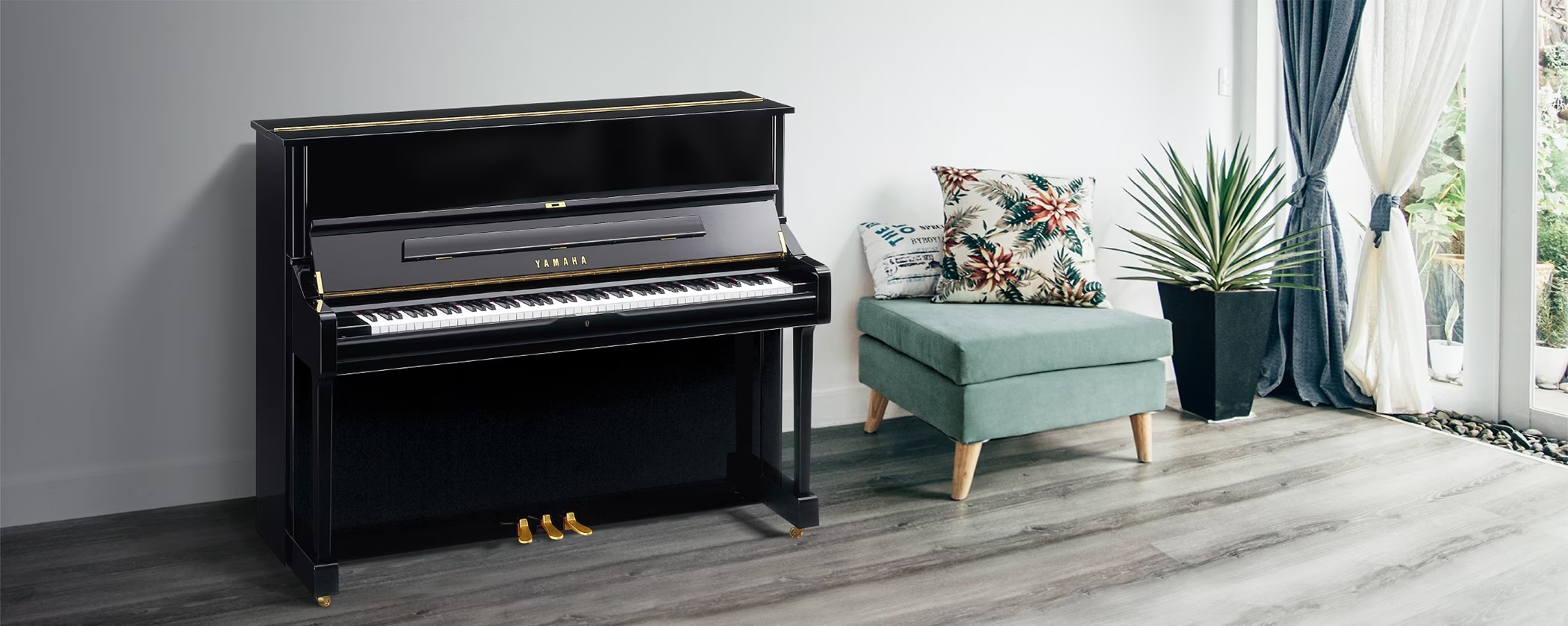
To B or not to B? That is the question being posed by Yamaha, the name at the very forefront of worldwide piano sales. And the beginner b Series piano is one of the bestselling acoustic pianos ever. That’s because it’s the first piano purchase for many people, thanks to its relatively affordable price (you can get a brand new one for a little less than $5k/£4k), its quality, and simply the respect of having the Yamaha in gold letters above the piano keys.

Often touted as the best choice for piano teachers and students, it’s one of the more compact and portable acoustic upright pianos out there, and has that trademark, lovely Yamaha upright aesthetic with options for mahogany, ebony, and more finishes to suit your taste and home/studio. And, unless you have a particularly expensive and premium taste in piano sound, we’re willing to bet you will be more than happy with the b Series’ lovely tone, suitable for all manner of genres and styles, and impressive for a smaller piano.

VIEW PIANO


Kawai K-300

Pro: Rich, warm tone, superb value for money.

Con: May not suit players who prefer a brighter sound.

They sure know how to make pianos in Japan, hey? Kawai and Yamaha have been big rivals in the acoustic piano game for a long time now, and the K-300 is a big rival to the latter’s own beginner upright pianos. And the quality of Japanese design, despite this Kawai coming at the lower end of the piano pricing spectrum, represents a brilliant balance between being a great acoustic piano for smaller spaces, while being big enough to give you that beautiful Kawai piano sound. Next to the Yamaha b Series, the K-300 sounds less bright, having a warm sound with impressive tonal depth for a smaller upright piano.

The double-felted hammers, activated via the middle pedal, are wonderful to have when you need to play quietly and keep the neighbours happy, and other features like the extended rest for sheet music and a soft-fall lid to safely close the instrument represent Kawai’s great attention to detail.

VIEW PIANO


Yamaha U3

Pro: Powerful sound, durable build, professional action.

Con: Can have a very bright tone, heavy and difficult to move.

Back over to Yamaha, and the U3 is a true industry workhorse and one of the most popular upright pianos ever made, earning its reputation as an outstanding choice for both serious students and professional settings. The reason is its expert features, including its tall cabinet and extended string length, which give it a powerful and rich sound that can fill a room, even going toe to toe with the presence of a small grand piano. It’s a big old durable upright, so you can be very confident this is an acoustic piano built to last. With a consistently reliable action that provides a responsive touch, the U3 offers a trademark blend of performance and build quality. There’s a good reason it’s such a common sight in music schools, recording studios, and homes worldwide.

VIEW PIANO


C. Bechstein Concert 8

Pro: Exceptional lyrical tone, powerful dynamic range.

Con: Very high cost, large size can overpower a room.

‘A concert grand in a piano's clothing.’ Is the C. Bechstein Concert 8 one of the best acoustic pianos out there, or is the claim that they’ve packed the tone and power of a grand piano into an upright just marketing spiel? No, actually, as this is one exceptional upright. The fact that Bechstein is the chosen name of contemporary composers and pianists Hania Rani and Ólafur Arnalds, who are both very picky about their piano sound, is a strong sign of what kind of quality you’re getting here.

We’re now looking at pianos hitting five figures, and the Concert 8 is certainly no budget piano. This is an upright piano that genuinely does hold many of the qualities of a much more expensive grand piano, and has been lauded worldwide for several decades. It can generate huge power and volume for an upright, while sounding heart-wrenching when playing quieter passages of music. The action of the hammers and the responsiveness of the keys are world-class.

VIEW PIANO


Yamaha CFX

Pro: Crystal-clear clarity, excellent projection for concerts.

Con: Bright tone is not to every pianist's taste.

Yamaha has one final say in this best acoustic piano conversation with the Yamaha CFX Concert Grand. Yamaha calls it ‘the crowning glory’ of the company’s piano line, and as soon as your fingers touch the keys, it’s not difficult to see why. Some of the contemporary artists who have aligned with this particular acoustic piano include Elton John, Annie Lennox, and Nils Frahm (listen to the explosive finale of Says to hear its thunderous power in modern music). If you are looking for professional and concert hall-ready key action, response, expressiveness, and nuanced phrasing, then this acoustic grand piano has all of this in spades. Yamaha states that 19 years of research and craftsmanship went into the creation of the CFX, and it sounds equally incredible when played at full volume or pianissimo.

VIEW PIANO


Una Corda

Pro: Unique, pure, and transparent tone for niche sounds.

Con: Not a standard piano, very expensive and bespoke.

So far, with the exception of the Keybird, we’ve only looked at acoustic pianos that fit the traditional mould of both sound and design. But two men who don’t approach the piano in a traditional way are piano designer and engineer David Klavins, and pianist/composer Nils Frahm. When Klavins met Frahm in 2014, he was inspired to build an entirely new instrument based on Frahm’s influential approach to the instrument. Hence, the Una Corda is the biggest curveball on this best acoustic piano list. It doesn’t look or sound like any traditional piano, but it would look stunning in an arty or minimalist space for those looking for a more contemporary piano sound.

It features a one string per piano note design, and sounds incredible for warm, felted sounds or brighter bell tones. Perhaps not the one on this list for you if you want to have friends round and play the works of Mozart and Brahms. That said, it's also one of the easiest pianos to tune out there, and is very lightweight compared to some of the beasts in this piano list, so it's brilliant for modern touring artists also. The Klavins website also states that it's one of the most sustainable pianos ever made, with very little waste.

VIEW PIANO


Kawai SK-EX Concert Grand

Pro: Highly expressive and intimate tone, meticulously crafted.

Con: Very exclusive and difficult to acquire.

It’s time for Kawai’s take on the best acoustic grand piano, and they present a very strong case with the SK-EX Concert Grand. To give you an idea of what a special acoustic piano this is, Kawai only makes 20 of the things each year for the entire world. Its sound and tone are quite magnificent, even better than you’d imagine after so much thought and craft going into each of these very rare instruments. That rarity and quality do mean we’re now wading into six-figure pricing. But for that small fortune, you can enjoy its Shiko Seion hammers, meticulously hand-pressed and voiced for outstanding dynamic expression. And the fact that each acoustic grand piano is built upon the acclaimed Millennium III action with ABS Carbon components for superior speed and control. This is about as exclusive as the piano club can get, but it is acoustic piano craftsmanship at its absolute finest.

VIEW PIANO


Bösendorfer 290 Imperial

Pro: Full, orchestral sound with extra-wide keyboard.

Con: Massive size, rich sound not ideal for all music genres.

Just try saying ‘Bösendorfer’ out loud, and the word alone will make you feel more elegant and sumptuous. Our penultimate piano is the legendary 290 Imperial, as we finish with two pianos that cost more than a modestly priced house. The Austrian acoustic piano manufacturers have a strict limit of crafting only 300 of these grand pianos a year, and each one’s appearance is tailor-made to the buyer’s request. That’s right — if you want your 290 Imperial to be blue, Bösendorfer will honour that request. Aesthetics aside, the Imperial is instantly recognisable for its warm, full, and dark tonal palette, often described as having an orchestral or bell-like quality. Unlike some of the brighter-sounding pianos on this list, the Bösendorfer's resonance is deep and sustained. The bass register sounds truly beautiful, as does the sound of every other key you press on this instrument. A most noble piano indeed.

VIEW PIANO


Steinway Model D

Pro: Industry standard, powerful and versatile.

Con: Less individual character compared to boutique brands.

If you were chatting to a piano expert about the best acoustic pianos and you mentioned the Steinway Model D, I’d be willing to bet they’d let out a big, happy sigh just to hear the name. Pianist Mitsuko Uchida is on record saying, “Once you start playing on a Steinway Model D, then you play differently. They are a different animal. And that is a privilege to have.” Hopefully, the price makes this all too obvious, but this is no beginner piano; it was created with the world’s finest pianists in mind. Expect a bass register that you feel in your soul, a resonant tone all round, and a sparkling treble. It comes in the iconic Steinway high gloss black finish. As cheesy as it might sound, the Steinway Model D isn’t just an acoustic grand piano; it’s an experience, and one that will change you.

VIEW PIANO


How to find the best second-hand acoustic piano for your needs

If the prices of the best acoustic pianos above have you sprinting back to look at the best digital pianos, not so fast! If you’re not a land-owning aristocrat, an acoustic piano is clearly a very expensive purchase when bought brand new. But there are several options to significantly lower the cost. First of all, you can get them for free! People are often giving them away via up-cycling apps and websites just to get the piano off their hands and free up some much-needed space. Of course, this approach requires caution — do your due diligence by researching the piano brand and model in question, and always go and try the piano out for yourself before committing to agreeing to the adoption. These free pianos can be in questionable, if not downright awful, condition. If it just needs a minor bit of tuning and refurbishment, fine, but sometimes the level of work needed can become a huge hidden cost.

Otherwise, you can buy second-hand pianos in all manner of ways. The most reliable route, while not the cheapest, is to buy a used acoustic piano from a reputable piano dealer or shop. This way, you know you’re getting a piano in decent condition. The best shops will have given the acoustic piano in question a full refurbishment, making it the next best thing to a brand new piano.

Read more: