A Brief History
I’ll be honest: this is the first iD interface I’ve used personally, although I’ve had plenty of experience with Audient gear over the years – including an analogue live console over two decades ago. Perhaps I shouldn’t be surprised, though.
Founded in 1997 by Dave Dearden and Gareth Davies (who met while working at Soundcraft in the late ’70s), Audient’s pedigree runs deep. Dearden’s earlier career saw him at Advision Studios, where he designed one of the first automated consoles before co-founding DDA (Dearden Davies Associates) in 1980. When DDA was later acquired by Klark Teknik and Midas, Dearden went on to design several classic consoles, including the Midas XL200, XL250, and Heritage 1000.
It’s no wonder, then, that Audient’s modern range remains firmly rooted in studio-grade design and performance nearly three decades on.
The Inputs
Headliner’s studio projects have made good use of Audient’s ASP800 and ASP880 preamps over the years, and both remain in our racks today. Their console-grade mic pres have long been a standout feature – and unsurprisingly, these have found their way into the iD range, including the new iD48 (albeit in simplified form).
Gone are the harmonic colouration circuits found on channels one and two of the ASP800 and the front-panel controls of the ASP880. Instead, these functions are now software-controlled. The mic preamps themselves are essentially the same as those found in Audient’s flagship 8024 console and across most of the company’s range.
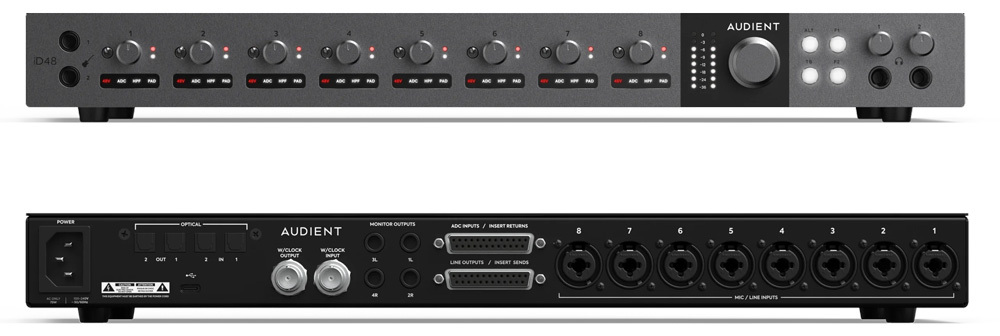
It’s easy to see why: they’re superb. The sweepable high-pass filter (HPF) from the ASP880 has been replaced with a fixed 100Hz option, alongside pad, boost, phase reverse, and input mode controls – all managed via the software interface.
Phantom power is toggled by a mini switch beside each gain control, with LEDs for phantom, input mode, HPF, and pad. The front panel offers basic signal and peak metering, with more detailed level control handled within the software.
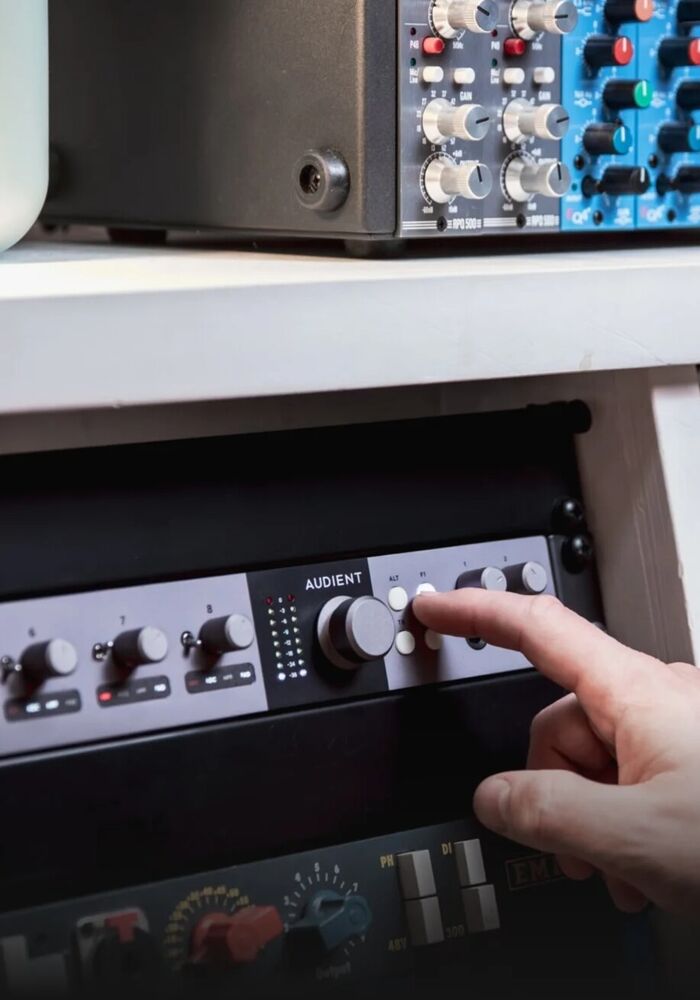
The front panel also features two instrument-level inputs for guitar or bass, addressable via the software on channels one and two. Two stereo headphone outputs, each with independent level control, sit on the right-hand side. A large rotary encoder controls master monitor volume, while four hotkeys provide quick access to Alt Speaker, Dim, Cut, Talkback, and Mono functions.
Buttons one and two are also assignable via the software. Despite the impressive routing options, the control software remains refreshingly simple, taking the form of a clear, intuitive mixer. Given the flexibility on offer, it’s remarkable how easy it is to navigate.