
Subscribe
Music News

AlphaTheta releases We Become One documentary on the power of shared musical experiences

AlphaTheta has announced the release of We Become One, a new documentary film exploring the power of shared musical experiences.

AlphaTheta’s mission, One Through Music, is based on a  belief that music has the profound power to unite people. From dancefloors to festivals, music has an ability to create shared experiences, dissolve boundaries, and bring us into a collective state of flow. But why does this happen? What is it about music that connects us so deeply?

We Become One follows DJ/producer/curator Kikelomo Oludemi as she goes on a journey to learn why people choose music as a vehicle to connect with others, appreciating it as a universal "language" that speaks to everyone. And how the human brain harnesses sound to evoke euphoria and reduce stress.

In We Become One, Oludemi travels to the USA, Ghana, South Africa, Germany, the UK, and France to talk with industry-leading scientists and researchers, and legendary artists. 

In California, she meets Daniel Levitin, a globally revered cognitive psychologist, neuroscientist, musician, and record producer, who explains how neurons in the human brain are fired synchronously with a beat, creating a wave-like phenomenon of electrical impulses.

“Why are they sending out electricity?” Levitin ponders. “They’re trying to spur the production and release of different chemicals. These different brain states characterise different states of consciousness.”

people with completely different experiences somehow feel the same emotions on the dancefloor.

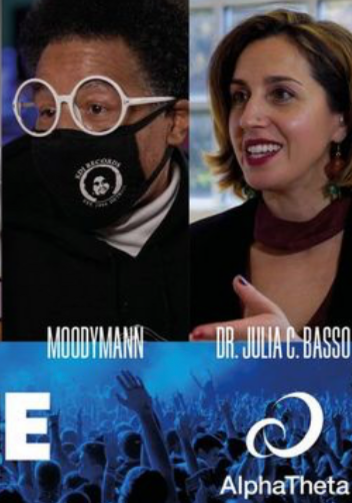
Another expert who talks about the way music triggers electrical activity in the brain is Dr. Julia C. Basso, neuroscientist and director of the Embodied Brain Lab. 

She explains how, when people are dancing to the same music together, specific parts of their brains are stimulated simultaneously, creating a feeling of unity among the crowd. “That whole social network of brain areas is lighting up, firing together, so there’s a lot of inter-brain synchrony that’s happening,” says Basso.

Where there’s music and dancing, there are usually lights too, and in We Become One we hear from Dan Ghenacia, a respected DJ and member of production trio Apollonia, who’s also the creator of the Alpha Wave Experience. 

Inspired by Brion Gysin’s Dream Machine, and backed by neuroscience, the experience uses a machine that combines flashing lights with music to create brain entrainment and induce people into different brain states, such as psychedelic or meditative ones.

“Clubbing is an old form of shamanism – using rhythms and drums to put people in ecstatic states,” says psychologist Francisco Teixeira, who works with Ghenacia on the project. 

“Sound and music is a non-semantic [form of] communication, so you can communicate your emotions even to someone who doesn’t speak your language. I think that’s why even people with completely different experiences somehow feel the same emotions at the same time [when on the dancefloor]… Sound is the unifying form of communicating emotions.”

On her travels, Oludemi also visits Oroko Radio and Vibrate Studios, both in Accra, Ghana, to discover how electronic music can help bridge sociological division on and off the dancefloor.

And by the end of her journey, Oludemi shares with the viewer a greater understanding of what clubbing and shared musical experiences can do for us from a neurological, racial, gender, sexual orientation, spiritual, and human perspective.

As legendary DJ Moodymann says in the film, while talking about his Soul Skate parties where people enjoy music and dancing while roller skating: “When we get together… we become one.”